

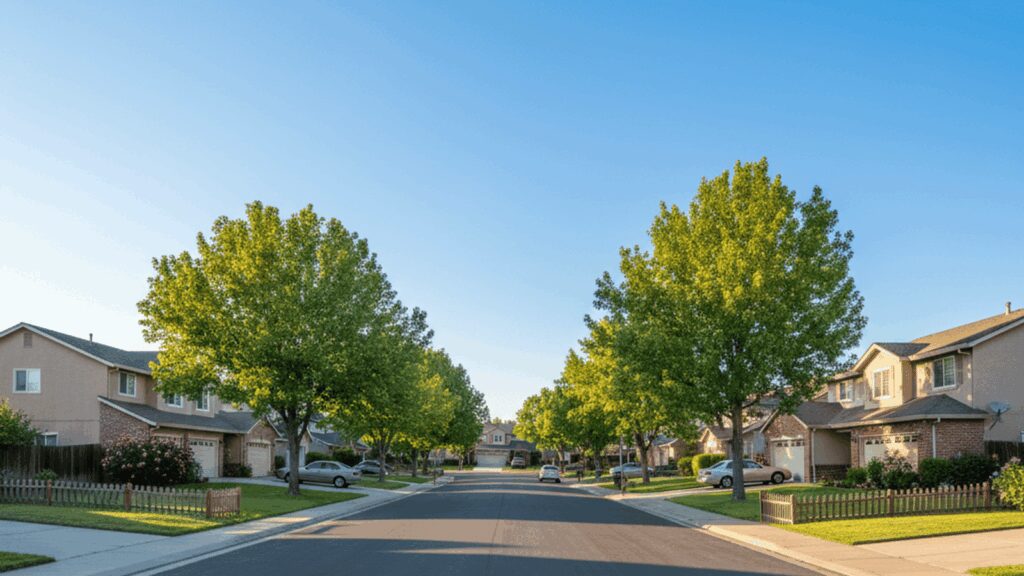
Picture this: You are looking at two beautiful homes in Roseville. Both are listed at $750,000. Both are about the same size. But when your lender runs the monthly payment numbers, one of them comes out nearly $400 higher than the other.
Why the massive difference? It usually isn’t the mortgage rate—it’s the property taxes.
If you are thinking about moving to Roseville, you have probably heard rumors about the “Mello-Roos” fees or the difference between “East” and “West” Roseville taxes. It can be confusing, but it is actually straightforward once you break it down. Unlike a standard sales tax, property taxes here have two distinct layers: the base rate mandated by the state, and the local “X-factor” that varies neighborhood by neighborhood.
Let’s unpack exactly how this works so you aren’t blindsided by your monthly payment.
How Proposition 13 Protects Roseville Homeowners
Before we get into the complex local fees, we need to look at the foundation of California property taxes: Proposition 13. This is the state law that serves as your financial safety net.
Prop 13 caps the general levy tax rate at 1% of the home’s assessed value. More importantly, it anchors your assessed value to your purchase price, not the current market value of the home in future years. If your home’s value skyrockets by 15% next year, the county cannot hike your assessed value by 15%. They are legally capped at a maximum increase of 2% per year as long as you own the property.
This means your base tax bill is incredibly predictable. While insurance and utilities might fluctuate, the bulk of your property tax bill will remain stable. However, keep in mind that this 1% base rate is just the starting point. The total bill you receive from Placer County includes special assessments that sit on top of that base, and that is where location starts to matter.
The Mello-Roos Factor: Why Location Matters
The biggest variable in your Roseville housing expenses is usually the Community Facilities District (CFD) taxes, locally known as Mello-Roos.
When developers build massive master-planned communities, the city needs new roads, schools, parks, and fire stations to support them. Instead of raising taxes on the existing residents in older neighborhoods to pay for this, the cost is passed directly to the buyers in those new communities through Mello-Roos bonds.
This creates a distinct geography of taxation in the city:
- East Roseville and Central Roseville: In established neighborhoods built before the early 2000s, Mello-Roos fees are often minimal or nonexistent. You might see small assessments for lighting or landscape districts, often totaling less than $500 a year.
- West Roseville: In newer areas like Fiddyment Farm, Westpark, and parts of Crocker Ranch, the infrastructure is new and extensive. Consequently, the Mello-Roos fees are higher.
It is important to understand that Mello-Roos is typically a fixed line item, not a percentage of your home’s value. Whether your home is worth $600,000 or $900,000, if you are in the same district with the same square footage, your Mello-Roos fee is likely the same. These fees generally range from a manageable $30 per month in older districts to over $400 per month in brand-new developments.
Also, check the expiration dates. The “bond” portion of these fees (which pays for the construction of infrastructure) usually has a term of 20 to 30 years. Once paid off, that portion drops off your bill. However, the “services” portion (which pays to mow the parks and light the streets) is usually perpetual.
How to Estimate Your Property Tax Bill
When you are trying to calculate your monthly budget, you can’t just multiply the purchase price by a single percentage and call it a day. You need a formula that accounts for the fixed charges.
To get a rough estimate of your total annual liability, use this structure:
- Base Tax: Purchase Price × 1%
- Voter Approved Bonds: Purchase Price × ~0.1% to 0.2% (for things like school bonds)
- Direct Charges: The fixed Mello-Roos and special assessments
Let’s look at how this plays out in real numbers for a $700,000 home in two different areas.
Example 1: The Established Neighborhood (e.g., Stoneridge) In an area with lower special assessments, your base tax is $7,000. Add in roughly $150 for voter bonds and perhaps $1,250 in fixed charges and landscape assessments.
- Total Estimated Tax: ~$8,400 per year
- Effective Tax Rate: ~1.2%
Example 2: The New Construction Area (e.g., Westpark) For that same $700,000 price point, your base tax is still $7,000. Voter bonds are similar. However, the Mello-Roos fees here might be around $4,000 annually to cover the new high school and parks.
- Total Estimated Tax: ~$11,500 per year
- Effective Tax Rate: ~1.65%
As you can see, the price of the home is the same, but the carrying cost is significantly different.
Roseville Taxes vs. Sacramento and Placer Neighbors
If you are debating between Roseville and nearby cities, it helps to look at the broader financial picture.
Compared to Sacramento, Roseville often has higher Mello-Roos fees because much of the housing stock is newer. Sacramento generally has a lower effective tax rate on average (hovering closer to 1.1% or 1.2% in many areas). However, you have to balance that against utility costs. Roseville owns its own electric utility, and bills can be significantly lower than PG&E rates in Sacramento. For many residents, the savings on electricity helps offset the higher property tax assessments.
When you look at Rocklin, specifically newer communities like Whitney Ranch, the tax profile is almost identical to West Roseville—high Mello-Roos in exchange for top-tier amenities and new schools. Older parts of Rocklin are more comparable to East Roseville. Lincoln can sometimes carry an even heavier tax burden relative to home values because they have very recent infrastructure bonds spread across a smaller population base.
Exemptions and Supplemental Bills
Once you buy a home, there are two pieces of mail you need to watch out for.
The first is the Homeowners’ Exemption. If the home is your primary residence, you can file a simple form with Placer County to reduce your assessed value by $7,000. It isn’t a huge windfall—it saves you about $70 a year—but it is money that belongs in your pocket, not the county’s.
The second is the Supplemental Tax Bill. This is the one that causes the most panic for new buyers.
Here is what happens: If the seller of your home bought it 20 years ago, their assessed value might have been $200,000. You just bought it for $700,000. The county tax collector’s system takes a few months to catch up. Initially, they might send a bill based on the old $200,000 value. A few months later, they will send a “Supplemental Bill” for the difference between the old taxes and your new taxes for the time you owned the home.
Warning: Many mortgage lenders do not pay the supplemental bill out of your escrow/impound account. They usually only pay the regular annual bill. When you get a supplemental bill, assume you need to pay it directly unless your lender confirms otherwise.
Frequently Asked Questions
What is the property tax rate in Roseville, CA for 2026?
The standard base rate is 1.0% of the assessed value. However, when you add in voter-approved bonds and special assessments, the “effective” tax rate generally lands between 1.1% in older neighborhoods and roughly 1.8% in newer developments with heavy infrastructure bonds.
How much are Mello-Roos fees in Roseville?
There is no single number, as it depends entirely on the specific district. Fees can range from as low as $300 per year in older areas to over $4,000 per year in new master-planned communities like Fiddyment Farm or Westpark.
Can I pay off Mello-Roos early?
You can usually pay off the “bond” portion of the Mello-Roos, which is the debt used to build the infrastructure. However, you cannot pay off the “services” portion that funds ongoing maintenance for parks and lighting.
When are Placer County property taxes due?
A handy way to remember the schedule is “No Darn Fooling.” The first installment is due November 1 and delinquent December 10. The second installment is due February 1 and delinquent April 10.
Why did I receive a supplemental tax bill?
This bill represents the catch-up amount between the seller’s old low tax rate and your new purchase price. It is a one-time adjustment for the period between closing and when the county updates the tax rolls for the next fiscal year.