

Updated on: November 2, 2026
The best neighborhoods in Roseville, CA fall into four groups: newer master-planned communities on the west side, established neighborhoods in north and central Roseville, larger-lot neighborhoods on the east side, and Sun City for buyers 55 and older.
Key Takeaway
Roseville is not one housing market, and choosing a neighborhood comes down to one trade-off. West-side master plans offer newer homes but usually add Mello-Roos and HOA costs and a longer drive to I-80. Established central and east neighborhoods offer resale homes, mature trees and usually no Mello-Roos. The highest prices sit on the east side, and buyers should check any parcel’s tax bill before making an offer.
Who This Guide Is For
Homebuyers comparing Roseville neighborhoods before starting a search.
More neighborhood guides: east, west, Woodcreek, Pleasant Grove, Blue Oaks, Creekside, Sun City Lincoln Hills, Old, Sierra Vista, Meadow Oaks, Campus Oaks. Side-by-side comparisons: Stoneridge vs Stoneridge West Village, Stoneridge vs Highlands, Fiddyment Farm vs Blue Oaks. Related guides: Most expensive areas in Roseville.
Roseville Neighborhoods at a Glance
- West-side CFD base-year maximum special taxes run about $900 to $2,280 yearly. A parcel’s current bill will differ.
- Newest plan areas for new construction: Sierra Vista, Amoruso Ranch, Creekview.
- Sun City requires one occupant 55 or older, plus monthly HOA dues.
- Central and east Roseville reach I-80 fastest. The west side drives farther.
- Commuter buses to Sacramento run weekdays only, at peak hours.
Roseville Neighborhoods Compared: Table and Map
The neighborhoods are not ranked, because the right one depends on your budget, the home age you want and your commute. Median prices move month to month, so compare all 15 neighborhoods using current medians from a single source and the same data month. City of Roseville Community Facilities Districts (CFDs) follow parcel boundaries rather than neighborhood names, so confirm any home’s status on the city’s CFD boundary maps or its tax bill.
- WestPark: West side. Master plan from the mid-2000s on, with a 55+ section built 2006 to 2014. Inside the WestPark CFD. Best for housing variety and planned parks.
- Fiddyment Farm: West side, north of WestPark. Newer single-family homes. Inside the Fiddyment Ranch CFD. Best for new construction near preserved open space.
- Sierra Vista: West side. Newest master plan, still building. Inside the Sierra Vista CFDs. Best for brand-new homes.
- Morgan Creek: West side. Golf-course homes. Check the parcel. Best for golf access.
- Sun City Roseville: Del Webb Specific Plan area. Single-family homes in an age-restricted community. Check the parcel. Best for 55+ amenities.
- Highland Reserve: North and central. Traditional suburban resale homes. Usually no Mello-Roos. Best for everyday convenience.
- Diamond Oaks: Central. Older resale homes near a 1963 municipal golf course. Usually outside the newer CFDs. Best for classic Roseville homes near golf.
- Blue Oaks: North. Established resale homes. Check the parcel. Best for resale value in north Roseville.
- Woodcreek Oaks: North. Resale homes around a 1995 city golf course. Check the parcel. Best for golf and oak-lined open space.
- Quail Glen: North. Established resale homes. Check the parcel. Best for mature trees at resale prices.
- Cirby Ranch: Central. Three- to five-bedroom homes built 1970 to 1999. Usually outside the newer CFDs. Best for established homes at lower price points.
- Cherry Glen: Central. Smaller homes built 1940 to 1969, some earlier. Usually outside the newer CFDs. Best for entry-level single-family homes.
- Old Roseville: Central, downtown. Early-1900s homes on smaller lots. Usually outside the newer CFDs. Best for walking to Vernon Street.
- Stoneridge: East side. Homes within a 1,117-acre plan with ravine open space. Check the parcel. Best for trail access.
- Johnson Ranch: East side. Larger lots with mature landscaping. Check the parcel. Best for large lots near Maidu Regional Park.
Most Roseville addresses fall in Roseville City School District for elementary and middle grades and Roseville Joint Union High School District for high school. Some addresses near the edges, such as those toward Granite Bay, fall outside the high school district.
The City of Roseville’s Specific Plans, Planning Areas & Development Agreements page has a clickable map of the city’s seventeen specific plan areas, the Infill Area and the North Industrial area. That map is the closest thing to an official neighborhood map. Several neighborhoods in this guide have their own plan area on it, including Stoneridge, Sierra Vista, Highland Reserve North and Del Webb (Sun City), and WestPark falls within the West Roseville Specific Plan. The city also publishes the map as a GIS layer through its open data service.
West Roseville: Newer Master-Planned Communities
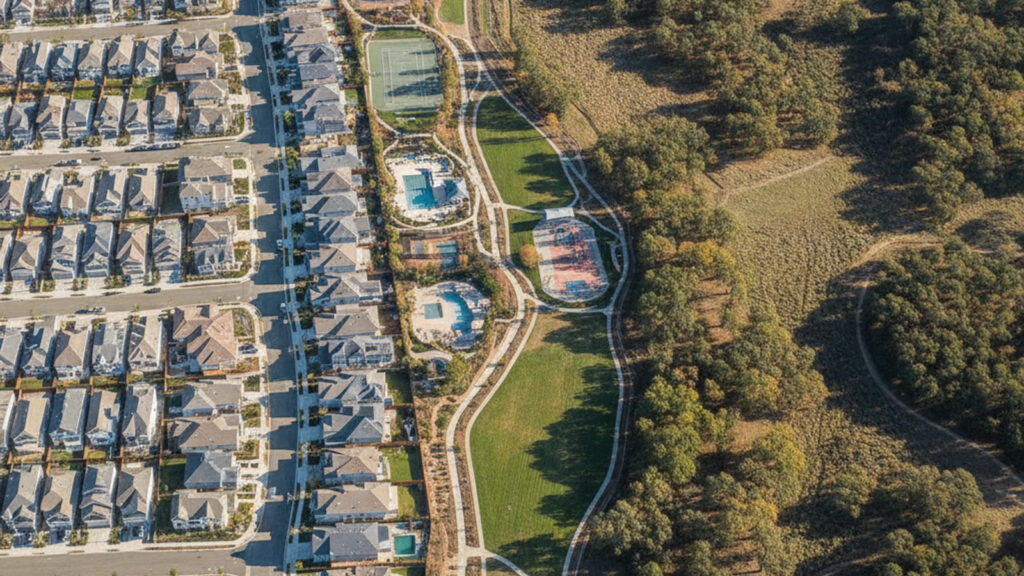
West Roseville has been the city’s main growth corridor over the last two decades, as the city grew outward from its older areas along Interstate 80. West of Highway 65, buyers get newer construction, energy-efficient designs, builder warranties, and trails and parks built into the subdivision plans. Those benefits come with carrying costs: many parcels pay CFD special taxes, and HOA dues are common. Retail has not kept pace with home building, and I-80 is a longer drive.
WestPark
Best for buyers who want a wide choice of newer homes and planned parks in one master plan.
WestPark is part of the city’s West Roseville Specific Plan. The city formed its WestPark public facilities CFD in September 2004, and building followed through the mid-2000s and 2010s. Homes tend to sit on smaller lots with generous interior square footage. Village centers and large recreational spaces tie into the regional bike trails.
The 1,483-acre community includes The Club at WestPark, a Del Webb age-restricted section of 704 single-family homes built 2006 to 2014 with a 10,000-square-foot recreation center.
Trade-off: most errands mean a drive, and the CFD special tax adds to the yearly cost.
Fiddyment Farm
Best for buyers shopping new construction next to preserved open space.
Located just north of WestPark, the Fiddyment Farm neighborhood blends residential development with preserved open space and agricultural history. The neighborhood layout protects several historic oak tree groves and natural creeks.
Housing ranges from entry-level single-family homes to larger builds on the neighborhood’s perimeter, and newer schools and community centers were built to serve the area. The neighborhood falls under the city’s Fiddyment Ranch CFD, which includes annexation areas such as Rosepark.
Trade-off: shopping and dining nearby are limited.
Sierra Vista & Other Active New-Home Areas
Best for buyers who want a home no one has lived in yet.
Sierra Vista is west Roseville’s newest master plan and has its own CFDs. Amoruso Ranch and Creekview are the other newest specific plan areas, each with its own CFD, and they are where new homes keep appearing. Campus Oaks is another newer area with its own CFD.
Buying new means the builder sets the price and the incentives, and finished parks and schools can arrive years after the first homes close. Ask the builder for the CFD disclosure and the maximum special tax on the lot before you sign.
Trade-off: construction is ongoing around you.
Morgan Creek
Best for buyers who want a home near a golf course.
Morgan Creek is built around Morgan Creek Golf Club, which opened in 2003. The club is open to the public and requires no membership: golfers pay a green fee to play. Golf access is separate from the neighborhood’s HOA, and owning a home here gives no golf privileges beyond those any visitor has. HOA dues differ by village, so get the current amount from the HOA disclosures for the specific home.
Trade-off: green fees come on top of HOA dues.
North & Central Roseville: Established Neighborhoods
Streets are wider here and landscaping is mature. Many homes date from the 1980s to early 2000s, and lots tend to be larger than in the newest west-side plans. Proximity to major shopping and the city’s hospitals drives demand.
Highland Reserve
Best for buyers who want everyday convenience.
Highland Reserve sits near Highway 65, close to the Westfield Galleria, the Fountains, both major hospitals and commuter routes. The homes have traditional suburban architecture, well-maintained sidewalks and mature shade trees. The city’s Highland Reserve North Specific Plan covers part of the area.
Nearby commercial plazas house major grocery chains, restaurants and big-box retailers. Expect strong competition for listings here because of the central location and the general lack of Mello-Roos fees.
Trade-off: some homes still have original interiors that need updating, and through-streets carry traffic.
Diamond Oaks
Best for buyers who want a classic Roseville home near golf.
Diamond Oaks takes its name from Diamond Oaks Municipal Golf Course on Diamond Oaks Road, a city course built in 1963. The neighborhood offers older resale homes, mature trees and established yards close to central Roseville’s shopping and I-80. Whether a home backs onto the course, and the lot size, differ from street to street, so check each listing.
Trade-off: older homes often need updates to roofs, systems or kitchens.
Blue Oaks, Woodcreek Oaks & Quail Glen
These three north Roseville neighborhoods offer established homes that typically cost less than the newest west-side builds.
Blue Oaks is best for buyers who want a resale home in north Roseville with access to the Blue Oaks corridor and Highway 65. Prices reflect existing finishes and condition rather than builder pricing.
Woodcreek Oaks is best for golf and open space. It surrounds Woodcreek Golf Club, a City of Roseville public course designed by Robert Muir Graves in 1995. The course has 18 holes set among mature oaks and native wetland habitat, plus a lighted driving range.
Quail Glen is best for mature trees at resale prices. Neighboring Pleasant Grove offers a similar mix of resale homes, so it is worth searching both at once.
Trade-off for all three: homes are older than the new builds, so inspection findings and update costs matter more.
Cirby Ranch, Cherry Glen & Old Roseville
These are Roseville’s more affordable established options.
Cirby Ranch has three- and four-bedroom homes up to five-bedroom homes, plus apartment complexes. Most were built between 1970 and 1999.
Cherry Glen is older. Its homes range from studios and two-bedrooms to three- and four-bedroom houses, mostly built between 1940 and 1969, with some built before 1940.
Old Roseville is the historic downtown, with smaller lots, single-family homes, a train depot and shops. Its building stock dates to the early 1900s: the Chamber of Commerce building at 700 Vernon Street was built in 1915. The city’s Downtown Specific Plan aims to restore Historic Old Town, Vernon Street and Royer Park as the heart of Roseville, which makes this the area for walking to downtown.
Trade-off: older housing stock means higher inspection and update costs, especially for plumbing, electrical and foundations.
East Roseville: Established Larger-Lot Neighborhoods
The east side holds established neighborhoods with larger lots, ravine trails, parks and quick access to I-80 and Douglas Boulevard. This is where Roseville’s highest median prices sit. Granite Bay borders Roseville but is unincorporated Placer County, so its taxes and services differ from those of homes inside the city.
Stoneridge
Best for buyers who want trail access and open space.
The city defines Stoneridge through the Stoneridge Specific Plan, a 1,117-acre area bounded by Rocklin to the north, Interstate 80, Secret Ravine and Roseville Parkway to the west, Olympus Drive to the south and Sierra College Boulevard to the east. The plan set aside more than 285 acres for parks and open space along Miner’s, False and Secret Ravines. The Miners Ravine Trail connects to a historic grinding-rock site, and the False Ravine Trail also runs through the area. Lots and open-space frontage drive prices here more than home age does.
Trade-off: there is no grocery store inside the neighborhood.
Johnson Ranch
Best for buyers who want mature landscaping and large lots.
Johnson Ranch centers on Maidu Regional Park, which sits within the neighborhood and includes the Maidu Museum & Historic Site. The Johnson Ranch Sports Club offers tennis programs, lap swimming, water fitness and youth swim lessons. Buying a home here does not include a club membership: residents who want one arrange and pay for it separately.
Because Johnson Ranch borders Granite Bay, confirm on the tax bill that a listing is inside Roseville city limits.
Trade-off: low turnover means few listings at any time, and lots backing onto Douglas Boulevard get road noise.
Sun City Roseville: 55+ Active Adult Community
Sun City Roseville is a dedicated 55+ community developed by Del Webb in the Del Webb Specific Plan area, with over 3,000 single-family homes. The community centers on two private golf courses, a large recreation center and numerous indoor and outdoor athletic facilities.
At least one resident must be 55 or older to purchase a home here. The homeowners association maintains the common areas and organizes community events, and buyers should factor the monthly HOA dues into their housing budget. Get the current dues from the association before making an offer.
Buyers 55 and older who want newer homes or a smaller community can also compare The Club at WestPark and Roseville’s other retirement communities.
Trade-off: the age requirement also applies when you sell, which limits who can buy your home.
How to Choose the Right Roseville Neighborhood
Start with the full monthly cost, then weigh age, lot and commute.
- Budget: Set your price ceiling from recent sales in the Roseville housing market for the neighborhoods on your list.
- New construction or resale: Weigh the west-side trade-offs above against the update costs that come with an older home.
- Carrying costs: A CFD special tax and HOA dues can add hundreds of dollars a month, so compare the total monthly payment, not just the list price.
- School districts: Boundaries follow addresses, not neighborhood names, so check school ratings and address-level boundary lookups before you write an offer.
- Commute: Weigh the west side’s longer drive to I-80 against its newer homes.
- Lot size: If yard matters, start with the established north, central and east neighborhoods.
Utilities, insurance and daily expenses also shape the Roseville cost of living beyond the mortgage. For crime and safety data, check recent reports for the specific streets you are considering. Weighing Roseville vs Folsom comes down to the same factors: home prices, home age, Mello-Roos and the drive to work.
If you’d like help narrowing these 15 neighborhoods to the two or three that fit your budget, I’m happy to set up a buyer consultation.
Frequently Asked Questions
What Is the Average Commute Time from Roseville to Sacramento?
Drive time depends on which side of town you start from. Central and east Roseville sit next to I-80. West-side residents first reach it through Highway 65, Baseline Road or the Blue Oaks corridor, which adds time. Roseville Transit’s commuter express buses run to downtown Sacramento on weekdays only, roughly 5 to 9 a.m. and 3:30 to 6:30 p.m. Amtrak’s Capitol Corridor stops at the Roseville station, mostly on weekdays, with a smaller weekend schedule.
Which Roseville Neighborhoods Have Mello-Roos Fees?
Newer west-side master plans such as WestPark, Fiddyment Farm and Sierra Vista sit inside city CFDs. Older central and east areas such as Cherry Glen, Old Roseville and Highland Reserve usually do not.
City bond documents show maximum annual special taxes of $900 to $1,300 per detached home in the WestPark CFD (2004-05 base year) and $1,500 to $2,280 in the Campus Oaks CFD (2015-16 base year). The Villages at Sierra Vista CFD set $1,987.35 per low-density home and $1,766.53 per medium-density home for 2023-24. These are maximums set in bond documents, not current bills. WestPark also has a separate WestPark CFD No. 2 for public services, which funds maintenance within the West Roseville Specific Plan, so one parcel’s bill can carry more than one special tax line. City policy caps the combined special tax and overlapping debt at 1.75% of a home’s expected market value. A specific parcel’s Roseville property tax bill shows what it pays, so check it before making an offer.
Which Roseville Areas Are Closest to Major Shopping?
Highland Reserve and Harding in central Roseville sit closest to the Westfield Galleria and the Fountains at Roseville, both right off Highway 65 in the center of the city.
Which Roseville Neighborhood Has the Most Expensive Homes?
Stoneridge and Johnson Ranch, on the east side, have Roseville’s highest median prices.
Where Can I Buy a Brand-New Home in Roseville?
New homes are concentrated in west Roseville: Sierra Vista, Amoruso Ranch, Creekview and the remaining phases of Fiddyment Farm.
Sources
- City of Roseville: CFD / Mello-Roos Services Districts
- City of Roseville: Westpark CFD No. 1 Official Statement
- City of Roseville: Specific Plans, Planning Areas & Development Agreements
- Roseville City School District: Districting and Boundary Maps
- City of Roseville: Downtown Specific Plan Executive Summary
- City of Roseville: Woodcreek Golf Club
- City of Roseville: Roseville Transit Commuter Service
- 55places: The Club at WestPark
- Country of Clubs: Morgan Creek Golf Club
- GolfPass: Diamond Oaks Municipal Golf Course
- NeighborhoodScout: Cirby Ranch
- NeighborhoodScout: Cherry Glen
- Roseville Area Chamber of Commerce: Johnson Ranch Sports Club
- Wikipedia: Maidu Museum & Historic Site